Project
[06] Flâneur
2024

👉🏻︎
Project funded by the Düsseldorf Art Commission stadt.raum.experimente 2024.
Project: Performance art experiment
Project progress:Paris, France;
London, England;
Düsseldorf, Germany
In contemporary cities, routes, time, and speed are increasingly arranged before movement even begins. Navigation apps suggest the fastest path, public transport is scheduled down to the minute, and commercial and pedestrian spaces constantly guide where to pause, pass through, and move on. Over time, faster choices become easier and more readily accepted, and speed gradually turns into the default standard by which action is judged as reasonable.
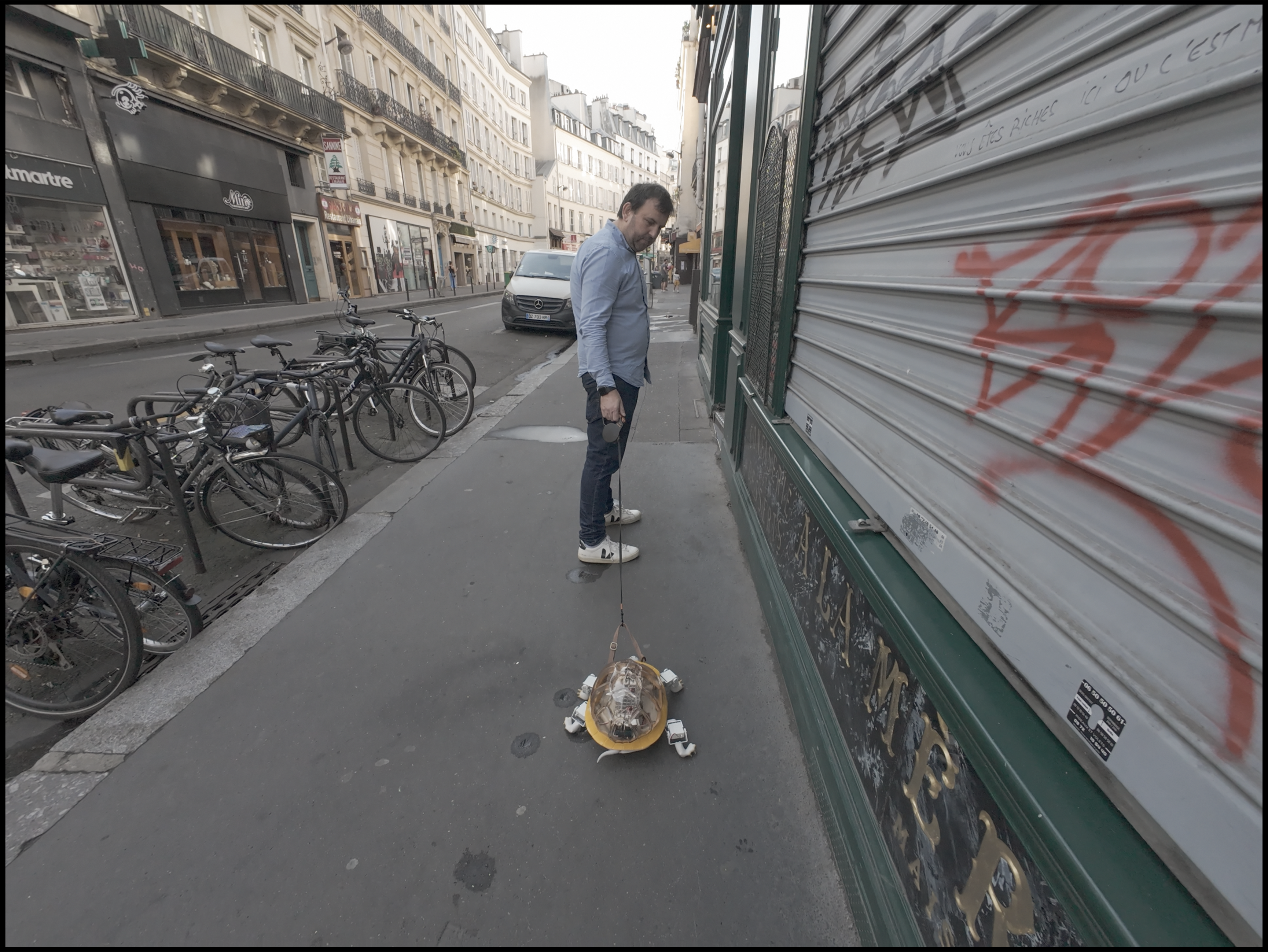
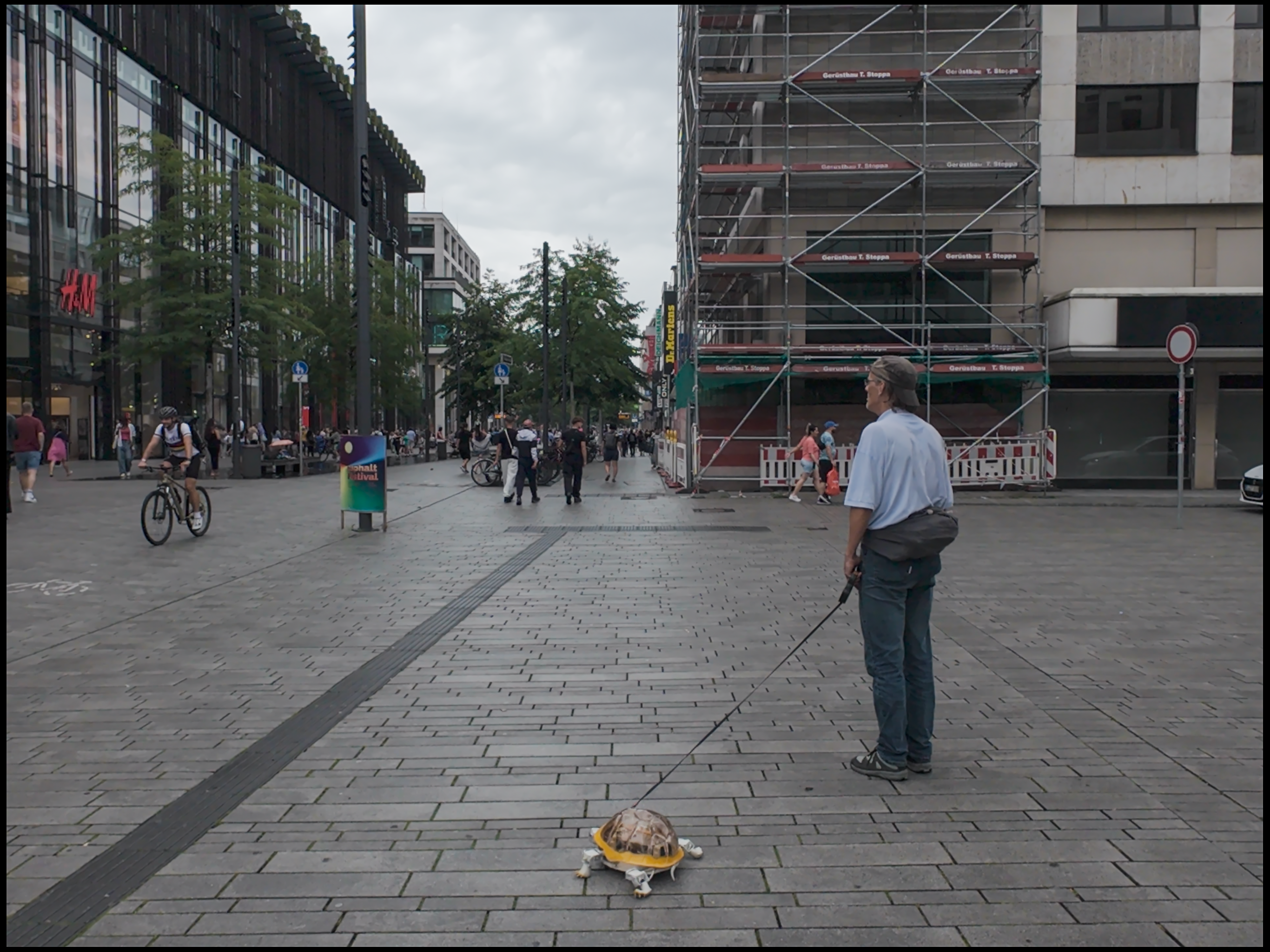
Since 2024, I have been developing Flâneur across different cities, inviting long-term local residents to lead a biomimetic turtle moving at a constant speed through the routes they know best in everyday life—crosswalks, commercial streets, residential areas, and parks. The turtle maintains the same pace throughout the action, without adjusting to crowds, traffic lights, or surrounding pedestrian flow.
When this constant slowness enters public spaces shaped by higher-speed movement, the movement patterns of others begin to shift. Some people walk around it, some slow down, and some briefly pause and wait. The normally smooth flow develops subtle deviations, yet the overall order does not stop; it continues by making local adjustments. It is through these small reorganizations that the speed usually hidden in the background begins to appear.
Flâneur is not only concerned with slowness itself, but with the way speed is organized, normalized, and repeated in the contemporary city. Through a simple but sustained action, the project brings the speed usually hidden in the background into the foreground. Perhaps the question is not only how fast we move, but why “faster” has come to feel like the only reasonable answer.
🐢
“Flâneur”是一个法语术语(此时资本主义和消费主义在欧洲蓬勃发展,为满足城市不断增长的消费需求新的城市模型开始孕育而成)。城市的漫游者在漫步中探索和观察城市空间,当代性,以及资本主义消费文化的出现和发展。传统意义中,flauner常常被视为独立的观察者,他们在城市中漫无目的的闲逛,从“远处”去观察这座被经济发展所改变的城市以及人们生活场所状态的变化。

我觉得flanuer它代表的不仅仅是19世纪法国的一种文化现象或者历史现象,它同时也代表了在19世纪的一种生活状态或者是一种生活方式。但是随着经济的发展,消费主义的盛行,伴随而来的是它不断调整和改变着我们的生活节奏,方式,喜好甚至是习惯。尤其是近几十年,全球经济飞速发展,城市化程度,科技水平不断提高,我们的生活变得更加高效和快捷,但时间和空间却让人们感受到前所未有的压迫感,从而让我们的体验和感知变得越发机械和快速。在这种状态下每个人都成为“社会机器”的重要参与者,冷静客观地去感受“城市”变得越发的理想化。


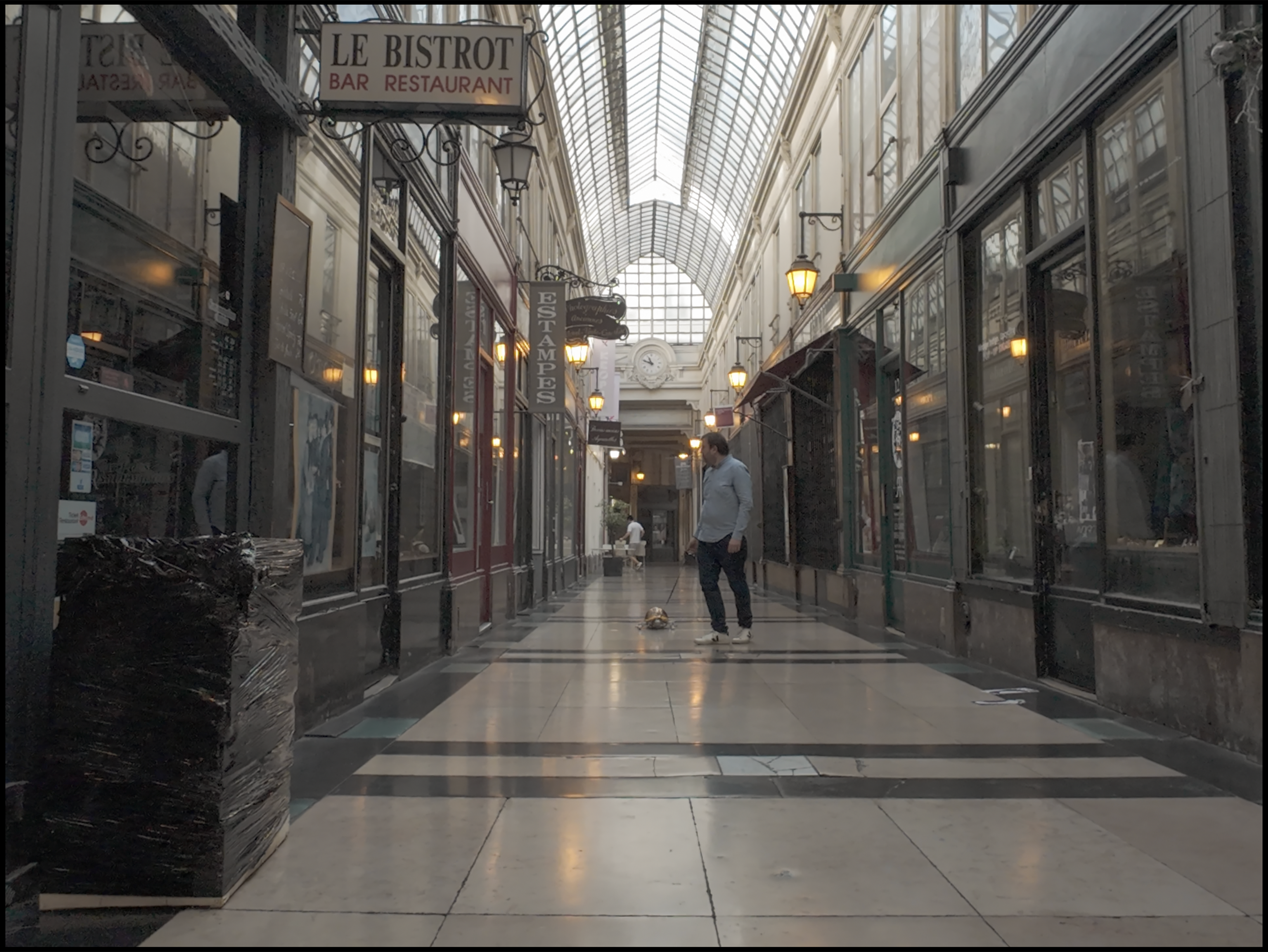
作品是受到本雅明《拱廊街计划》(1839年在巴黎,牵着乌龟在拱廊街散步是一件特别优雅的事情)的启发。将与巴黎当地人合作,通过牵着缓慢爬行的仿生乌龟机器人在巴黎城市街道漫步。将穿过同一空间下的不同历史“景观”,通过一种缓慢的方式重新审视和观察这个因经济发展和消费主义而改变的城市。


作品将通过摄像机记录下整个过程,通过和“flanuer”一起走上街头,记录如今城市日常风貌,玲琅满目的商品橱窗,精心搭配的高级服装,复古与现代的建筑,车水马龙的街道。Flanuer在这种环境如同插入公共空间的“异物”,为了适应当代空间它需要不断的变化和调整自己的状态。不管是人们对其投来异样或新奇的目光或者熟视无睹,flanuer这一行为都会成为现代化人类文明发展的异类。缓慢而不追求效率的状态最终会成为一种“自我陶醉式”的乌托邦幻境。

1839年,带着一只乌龟散步被视为是一种优雅的行为。它可以让人对在拱廊街漫步的节奏有一个概念。
本雅明